
Budgeting tips • Money mindset • Spending habits • Financial wellbeing • Cash flow
By Carrie-Ann McLean | Author
You started with good intentions.
You made a budget. You planned where your money would go. Maybe you were tracking your spending, putting money into savings or finally starting to make progress on your debt.
Then life happened.
The grocery bill was higher than expected. An unexpected expense popped up. You had a few weeks where you spent more than you planned. Or maybe you simply stopped looking at your budget altogether.
Sound familiar?
When your budget goes off track, it can be tempting to think you’ve failed and need to start all over again.
You don’t.
A budget isn’t something you either succeed or fail at. It’s a tool to help you manage your money and sometimes that tool needs adjusting as your life changes.
So if your budget hasn’t gone quite to plan lately, forget the guilt. Let’s look at what happened, make a few changes and get moving again.
Step 1: Reset – Look at Where You Are Now
The first step isn’t creating a brand-new budget.
It’s finding out where you are right now.
Open your banking app or pull up your budget and look at the last few weeks of spending. You don’t need to analyse every transaction or feel guilty about the takeaway you bought three Tuesdays ago.
You’re simply looking for the bigger picture.
Ask yourself:
- Where did most of my money go?
- Which expenses were higher than I expected?
- Were there unexpected costs I hadn’t allowed for?
- Did I spend more in certain areas when I was stressed, tired or overwhelmed?
- Is my current budget still realistic for what things actually cost?
This isn’t about finding everything you did “wrong”. It’s about gathering information.
Your bank account is showing you what happened. Now you can use that information to decide what happens next.

Step 2: Reflect – Work Out What Knocked Your Budget Off Track
Once you know where your money went, it’s worth asking why.
Sometimes the answer is straightforward. Your electricity bill went up. Your rent increased. Groceries cost more than you budgeted for. Your car needed repairs.
But sometimes there’s more going on.
Maybe you were having a stressful week and online shopping became an easy escape. Perhaps you were too tired to cook and takeaway crept into the budget more often. Maybe you kept saying yes to social plans because you didn’t want to miss out.
This is where budgeting becomes about more than numbers.
Our spending can be influenced by our emotions, habits, environment and the people around us. Understanding those patterns can help you make changes that actually last.
Instead of thinking: “I’m hopeless with money.”
Try asking: “What was happening when I made that decision, and what could I do differently next time?”
That’s a much more useful question. And don’t forget to look at what did go well.
Maybe you paid every bill on time. Perhaps you put $20 into savings. Maybe you walked away from an impulse purchase or cooked at home one extra night.
Financial progress isn’t only found in the big milestones. Small wins matter too.

Step 3: Rebuild – Make Your Budget Fit Your Life Now
Here’s something I think we need to talk about more:
If your budget continually doesn’t work, the answer isn’t always to try harder. Sometimes the budget itself needs to change.
A budget should be based on your real life – not the life you think you should be living.
If you’ve budgeted $150 a week for groceries but you’re consistently spending $190, simply writing $150 into next month’s budget isn’t going to solve the problem.
Look at what you can realistically afford and where you might be able to make adjustments elsewhere.
The same applies to fuel, utilities, insurance, school expenses, medical costs and all the other expenses that can change over time.
Your budget isn’t set in stone. Review it. Adjust it. Make it work for where you are now.
That’s not failing at budgeting. That’s budgeting.

Don’t Try to Fix Everything at Once
When we realise our finances have gone off track, it’s easy to swing too far in the other direction.
No takeaway. No coffees. No spending. No fun.
Everything gets cut at once.
The problem is that an overly restrictive budget can be difficult to maintain. A few weeks later, you’re frustrated, the restrictions disappear and you’re right back where you started.
Instead, choose one or two changes you can realistically make.
You might decide to:
- track your spending for the next seven days
- cancel a subscription you no longer use
- reduce takeaway by one meal a week
- transfer a small amount into savings each payday
- check your bank balance before making an unplanned purchase
- put a small buffer into your budget for unexpected expenses.
None of these changes will transform your finances overnight.
But that’s not the goal.
The goal is to start moving in the right direction again.
Build Some Breathing Room Into Your Budget
One reason budgets go off track is that we sometimes plan for everything to go perfectly.
But real life rarely works that way.
The car needs a new tyre. There’s a birthday you forgot about. The electricity bill is higher than expected. Something breaks at home.
If every dollar in your budget already has somewhere to go, one unexpected expense can throw everything out.
That’s why having a small buffer can make such a difference.
It doesn’t have to be hundreds of dollars.
Even putting aside $10 or $20 regularly can begin creating a little breathing room. Over time, you can work towards building an emergency fund so those unexpected expenses don’t automatically have to go onto a credit card or Buy Now Pay Later.
Start with what you can manage.
Small amounts still count.
Give Your Money a Simple Structure
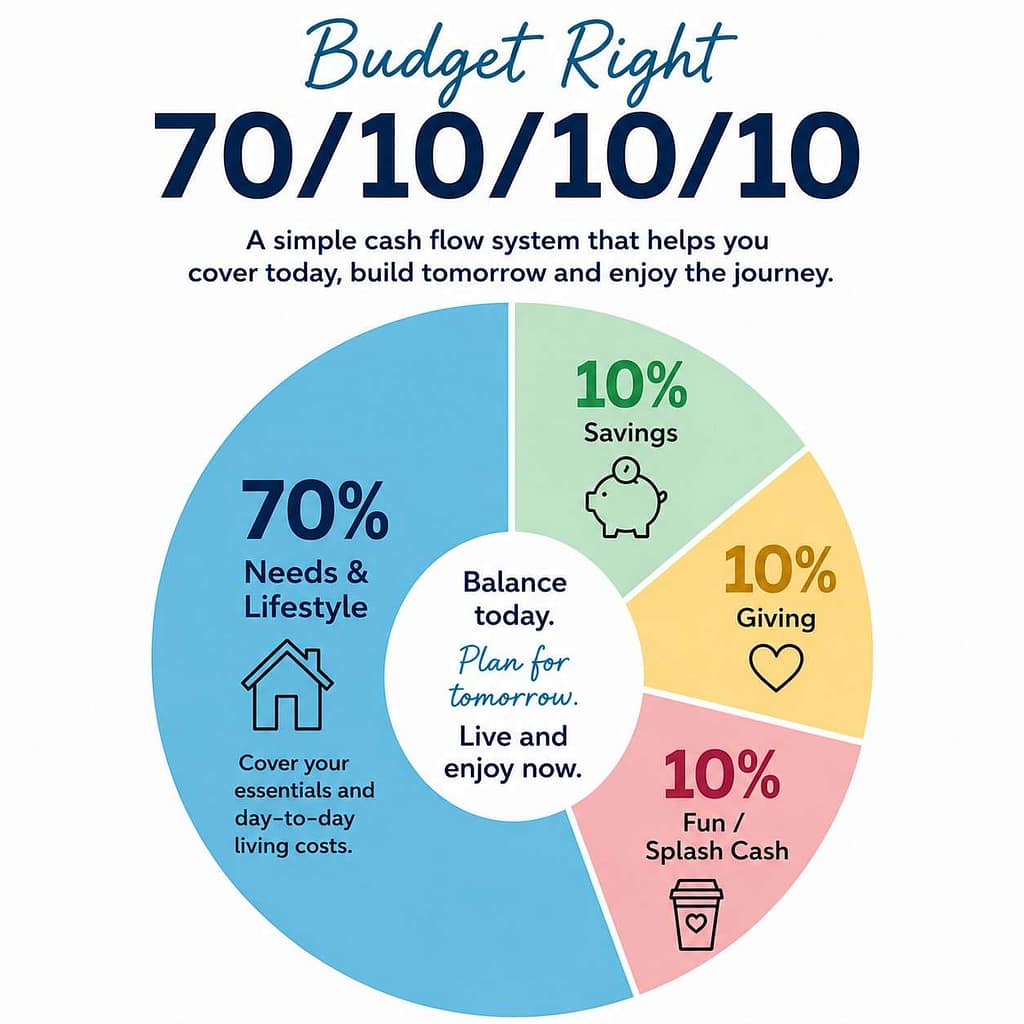
If budgeting feels complicated, simplifying the way you divide your money can help.
The Budget Right 70/10/10/10 Cashflow System is designed as a simple starting point:
- 70% – Needs & Lifestyle
- 10% – Savings
- 10% – Giving
- 10% – Fun/Splash Cash
These percentages aren’t about perfection. They’re a framework you can work towards and adjust to suit your circumstances.
If 70% isn’t enough to cover your essential expenses right now, don’t force the numbers. Look at your actual situation first.
The important part is knowing where your money needs to go and making intentional decisions about what’s left.
Your Budget Is Allowed to Change
The budget that worked for you six months ago might not work today. Your income may have changed, your rent or mortgage may have increased, or your grocery bill may look completely different.
You might have a new financial goal, an unexpected expense or a change in your family circumstances. That’s why a budget isn’t something you create once and then follow forever.
It’s something you come back to and adjust when you need to. When life changes, your budget can change with it.
You Don’t Need to Start From Zero
If there’s one thing I want you to take from this, it’s this:
Going off track doesn’t erase the progress you’ve already made.
You haven’t lost everything you learned about your spending.
You haven’t lost the habits you’ve already started building.
And you certainly don’t need to wait until Monday, next payday, next month or 1 January to begin again.
Open your budget.
Look at where you are.
Choose one thing you can change.
Then take the next step.
That’s what getting back on track looks like.
Not perfection.
Just progress.
Ready to Take the Next Step?
If your budget has gone off track and you’re ready to get some structure back around your money, Budget Right has practical tools and resources designed to help you understand where your money is going and make a plan that works in real life.
Explore the Budget Right books, budgeting tools and resources:
[Books & Resources]
Or, if you’d like some individual support:
Book a 1:1 Budget Coaching Session:
[Personal Help]
Budget Right provides financial education and general information only. It does not provide personal financial advice. Consider your own circumstances and seek professional advice where appropriate.
About the Author
Carrie-Ann McLean is an Author, Speaker, Budgeting Coach and Money Mindset Educator who helps everyday Australians improve their financial wellbeing without guilt, shame or overwhelm.
Drawing on her own lived experience of rebuilding her life after addiction, homelessness and significant debt, Carrie-Ann combines practical budgeting strategies with compassionate money mindset education to help people build lasting financial confidence.
She is the founder of Budget Right and the author of Budget Right: Eliminate Debt and Improve Your Financial and Mental Wellbeing and Money, Sorted. Life, Ready.
Disclaimer
This article is intended for general educational purposes only and does not constitute financial, legal or accounting advice. Please seek independent professional advice that considers your personal circumstances before making financial decisions.