
Teen girl and adult mentor discussing money habits and financial skills at a table with savings books and a piggy bank.

The Financial Skills Your Teen Won’t Learn at School (And How Parents Can Help)

Teaching teens about money • financial literacy for teenagers • money lessons for teens • financial skills for young adults

By Carrie-Ann McLean | Author | Speaker | Budgeting Coach | Money Mindset Educator

Over the years, I’ve worked with hundreds of young people through education, training and financial wellbeing programs.

One thing I’ve noticed is that many teenagers leave school with knowledge in a range of subjects, yet very little understanding of how money actually works in everyday life.

They know how to sit exams.

They know how to complete assignments.

They know how to use technology.

But many have never been shown how to:

  • Manage their first pay cheque
  • Create a simple budget
  • Build savings habits
  • Avoid impulse spending
  • Understand debt and credit
  • Make confident financial decisions

This isn’t a criticism of schools. Teachers already have enormous demands placed on them. But it does leave an important gap.

And that means parents, grandparents, carers and other trusted adults often become a young person’s most important source of money education.

Why Financial Education Matters More Than Ever

Today’s teenagers and young adults are growing up in a very different financial world than previous generations.

Many have access to:

  • Buy Now Pay Later services
  • Online shopping 24 hours a day
  • Subscription services
  • Social media advertising
  • Influencer spending culture
  • Instant payment technology

Spending money has never been easier, however learning how to manage it hasn’t. Unfortunately, many young adults are making financial decisions before they’ve been taught the skills needed to make those decisions confidently.

That’s why teaching teens about money is one of the most valuable life skills we can pass on.

Start With Conversations, Not Lectures

Money conversations don’t need to feel awkward.

In fact, some of the best discussions happen naturally. You might ask: Teen boy and trusted adult having a relaxed conversation about money and financial decisions at a table.

  • If you received $1,000 tomorrow, what would you do with it?
  • What are you currently saving for?
  • How do you decide if something is worth buying?
  • What money habits do you think successful people have?

Questions encourage thinking. Lectures often encourage eye-rolling.

The goal isn’t to tell young people what to think. The goal is to help them think about money differently.

Teach Them Where Their Money Goes

One of the biggest lessons young people can learn is that money doesn’t usually disappear because of one large purchase. More often, it slips away through a series of small spending decisions made throughout the week.

A coffee on the way to work, lunch with friends, a few online purchases, a subscription they forgot about or an unplanned night out may not seem significant on their own. However, when these expenses happen regularly, they can add up much faster than expected.

That’s why many people are surprised when they track their spending for a week or two. The goal isn’t to judge their spending. It’s simply to create awareness.

When young people can clearly see where their money is going, they often discover patterns they hadn’t noticed before. They may realise that small daily expenses are making it harder to reach their savings goals or achieve the things that matter most to them.

Awareness is often the first step towards better money management. Once they understand where their money is going, they can begin making more intentional decisions about where they want it to go instead.

Help Them Build a Simple Money System

One thing I wish I’d learned much earlier in life is that successful money management isn’t about being perfect.

It’s about having a system.

One framework I teach is the Budget Right 70/10/10/10 Rule. This Budget Rule provides a simple framework for managing money by allocating income towards living expenses, savings, giving and fun money.
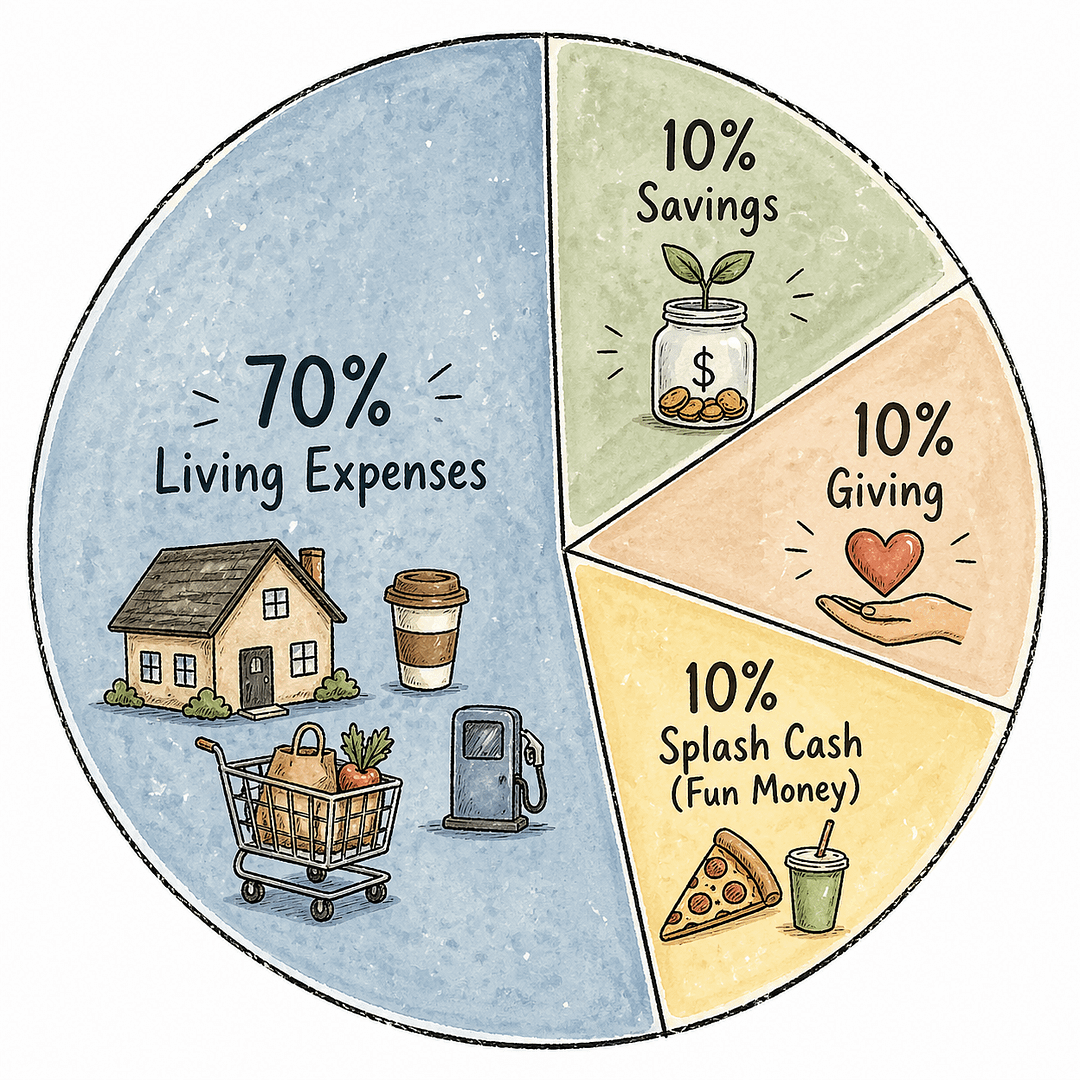
Illustration showing the Budget Right 70/10/10/10 budget rule with 70% living expenses, 10% savings, 10% giving and 10% splash cash.

  • 70% Needs and Lifestyle
  • 10% Savings
  • 10% Giving
  • 10% Fun Money

The exact percentages aren’t the point. The habit is.

When young people learn to give every dollar a purpose, they begin building confidence and control instead of constantly wondering where their money went.

You can also encourage them to discover their money personality through my Money Personality Quiz.

Talk About Spending Triggers

Most spending decisions aren’t purely logical. They’re often emotional.

People frequently spend money when they’re feeling stressed, bored, lonely, tired, excited or pressured by others.

Young people are no different.

Helping teens and young adults recognise these spending triggers early can save years of financial frustration later.

Rather than asking, “Why did you buy that?”, try asking, “What was happening when you decided to buy it?”

That small change encourages self-awareness and reflection instead of defensiveness.

When young people begin to understand the emotions behind their spending, they’re better equipped to make thoughtful financial decisions and build healthier money habits over time. 

Explain Debt Before They Need It

Many young adults encounter debt before they fully understand how it works.

This might include credit cards, Buy Now Pay Later services, personal loans, phone plans or car finance.

The issue isn’t that these products exist.

The issue is that many people start using them without understanding interest, repayments or the true cost of borrowing.

Simple conversations about debt can help young people make informed decisions and avoid costly mistakes later.

Helping them understand the difference between borrowing for a need and borrowing for a want can be an important lesson.

A little financial education today can prevent a lot of financial stress tomorrow.

Let Them Make Small Mistakes

Young woman looking thoughtfully at a nearly empty purse with bank cards while reflecting on her spending decisions.

This may sound surprising, but small money mistakes can be valuable teachers.

Spending all their pay too quickly.

Buying something they later regret.

Realising they should have saved for a goal.

These experiences help build financial awareness and decision-making skills.

The goal isn’t to prevent every mistake.

The goal is to help young people learn from them while the consequences are still relatively small.


Share Your Own Money Lessons

One of the most valuable things adults can do is talk openly about money. You don’t need a perfect financial history to teach someone about finances.

In fact, real-life experiences are often far more powerful than perfect examples.

Sharing lessons you’ve learned, mistakes you’ve made, challenges you’ve overcome and habits that have helped you can provide valuable insights for young people. These conversations help them understand that managing money is a skill that develops over time.

Young people often learn best from honest stories and practical experiences rather than theory alone.

I know I certainly wish someone had shared more of these lessons with me when I was younger.

A New Resource for Teens and Young Adults 

One of the reasons I wrote Money, Sorted. Life, Ready. was because I kept seeing young people leave school and enter adulthood without practical money skills.

Many knew how to earn money, however, far fewer knew how to manage it. They had never been taught how to budget, save for goals, understand debt, or make confident financial decisions.

That’s the gap this book was created to fill.

Money, Sorted. Life, Ready. covers important topics such as money mindset, spending habits, budgeting, saving, debt and credit, bank accounts, financial confidence and building healthy money habits that can last a lifetime. 

Money, Sorted. Life, Ready. is now available for pre-order and has been designed to help teens and young adults build stronger money habits, make informed financial decisions and create a more confident financial future.

Final Thoughts

Young people don’t need to become money experts before they leave school. However, they do need a starting point. A conversation about money, a simple budgeting system, a few healthy financial habits and a trusted adult who is willing to guide them can make a significant difference.

When young people understand how money works, they are better equipped to make informed decisions and avoid some of the common financial mistakes that many adults wish they had avoided. Learning how to manage money isn’t about getting everything right. It’s about building awareness, developing good habits and gaining confidence over time.

Financial literacy isn’t about perfection. It’s about making progress, learning from mistakes and creating a stronger foundation for the future.

And often, the lessons that make the biggest difference don’t start with a textbook or a classroom. They start with a simple conversation.

Support Note

If financial stress is affecting your mental health, you are not alone.

Support is available:

Australia

Lifeline – 13 11 14

Beyond Blue – 1300 22 4636

Salvation Army – 13 72 58

International

Visit https://findahelpline.com/ to locate support services in your country.

About the Author

Carrie-Ann McLean is an Author, Speaker, Budgeting Coach and Money Mindset Educator who helps everyday Australians improve their financial wellbeing without guilt, shame or overwhelm.

After overcoming addiction, homelessness and significant debt herself, she now shares practical, compassionate tools that help people rebuild both financially and emotionally.

Carrie-Ann is the founder of Budget Right and author of Budget Right: Eliminate Debt and Improve Your Financial and Mental Wellbeing and Money, Sorted. Life, Ready.

Disclaimer

This article is general educational information only and does not constitute financial advice. Please seek professional advice for your personal financial situation.

Shopping Cart
Scroll to Top