
How to Pay Off Debt Fast on a Low Income

How to Pay Off Debt Fast on a Low Income

Paying off debt when you’re on a low income can feel like trying to run up a down escalator. The bills pile up, the interest grows and sometimes it seems like you’re working just to stay broke. But here’s the truth: it is possible to get out of debt – even on a tight budget.

With a few mindset shifts and practical steps, you can take control of your money and speed up your debt-free journey. Let’s walk through how.

1. Know Exactly What You Owe

Before you can tackle your debt, you need to know what you’re dealing with. Grab a cuppa, sit down with your bills and write down:

  • The name of the lender

  • The total amount owed

  • The minimum monthly payment

  • The interest rate

Pro Tip: Use a simple spreadsheet or free printable (like the one offered through the Budget Right subscriber hub!) to track it all in one place.

This gives you a clear starting point, and trust me, it feels empowering just to see it.

2. Use the Budget Right 70/10/10/10 Rule
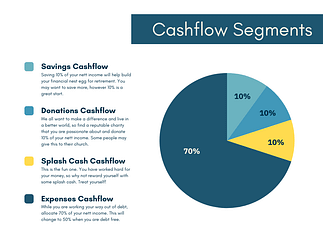
Budget Right Cashflow Segments 70/10/10/10 rule Living on a low income doesn’t mean you can’t budget. It just means your budget has to work smarter. That’s where the Budget Right 70/10/10/10 method comes in:

  • 70% for living expenses (bills, rent, groceries)

  • 10% for savings (start small!)

  • 10% for giving (if it aligns with your values)

  • 10% for splash cash (fun spending – yes, you’re allowed!)

Now here’s the twist: temporarily redirect your splash cash or giving funds toward your smallest debt. Even a little extra each month can make a big dent.

3. Find Your Expense Cashflow Excess (It’s Probably Hiding!)

You might be thinking, “I don’t have any extra money!” and that’s completely valid. But sometimes, small leaks sink big ships. Here’s how to uncover hidden cashflow in your 70% living expenses:

Step-by-step:

  • Track every dollar you spend for two weeks – yes, every single one!

  • Look at your essentials: Can you reduce grocery bills, switch energy providers or pause subscriptions?

  • Meal prep instead of buying lunch

  • Carpool, walk or use public transport where possible

  • Check for government concessions, rebates or Centrelink entitlements

Even $5 here and $20 there adds up. Most people can find $50–$150 in cashflow without changing their income – just by being intentional.

If you need help with this, grab my Budget Right Spreadsheet, it’ll show you exactly where your money is going and where your excess could be hiding.

Remember: You’re not cutting joy – you’re just choosing freedom over short-term spending.

Find Your Expense Cashflow Excess

4. Use Your Expense Cashflow Excess to Crush Debt (Starting Small!)

Here’s where the Budget Right method really shines. You’re already allocating 70% of your income to your living expenses – now it’s time to review that category and find your “excess” cashflow. That’s the extra money left over after paying your essential bills like rent, food, electricity and transport.

Here’s how it works:

  1. List all your debts from smallest to largest (regardless of interest rate).

  2. Pay the minimum payments on all of them.

  3. Take your excess cashflow from your 70% bucket and put it toward the smallest debt only.

  4. Once that smallest debt is paid off, roll the amount you were paying (minimum + excess) into the next smallest debt, while still paying minimums on the others.

Example:

Let’s say you have:

  • Credit Card 1: $400 ($25 min)

  • Credit Card 2: $1,200 ($50 min)

  • Buy Now Pay Later: $2,000 ($70 min)

You review your 70% living expenses and discover $80 of excess each month.

  • Pay minimums on Credit Card 2 and BNPL = $50 + $70 = $120
  • For Credit Card 1: pay $25 + $80 = $105/month

That $400 debt will be gone in under 4 months.
Now take that full $105 and add it to your next debt’s $50 minimum = $155/month to Credit Card 2.
Repeat this process until you’re debt free.

It’s simple, it’s empowering and it works even on a low income.

Pro Tip:  Cut up the credit cards and close the BNPL accounts once you have paid them off. You don’t want to fall into that debt trap cycle again.

5. Talk to Your Creditors (Yes, You Really Can!)

Another thing you can do to speed up your debt payoff is to talk to your creditors – especially if you’re feeling overwhelmed or falling behind. I know it can feel intimidating (I’ve been there), but opening up the conversation might just give you the breathing room you need.

In my book Budget Right, there’s a whole section called “Damage Control” that dives deep into how to take action when you’re drowning in debt.

There are two powerful steps in Damage Control:

STEP 1: Revisit Your Expenses

Cut back on non-essentials and look for opportunities to increase your cashflow (we covered this above). This is about regaining control of your money.

STEP 2: Seek Help

And the first part of seeking help is to talk to the very people you might be avoiding – your creditors.

Most lenders, banks and utility companies have hardship teams whose entire job is to help people like you. Reaching out doesn’t make you weak – it shows courage and responsibility.

Here’s what you can ask them:

  • Can they pause your repayments for a short time?

  • Will they freeze or reduce the interest?

  • Do they offer a financial hardship program or flexible payment plan?

  • Can they waive late fees or restructure your debt?

Even if the answer is “not right now,” starting the conversation opens the door to solutions.

What to say when you call or write:

You don’t have to spill every detail – just be honest. Here’s a script to get you started:

“Hi, I’m currently experiencing financial hardship and want to avoid falling behind on my payments. I’m committed to paying what I can and would like to know what support options might be available.”

You’ll likely speak to someone who has dealt with this before. Keep notes of who you spoke with, what they said and follow up in writing if needed.

Remember: This isn’t about shame. This is about owning your journey and doing what you can, with what you have, from where you are.

You Deserve to Be Debt-Free

You Deserve to Be Debt-Free

Paying off debt on a low income takes courage, persistence and a plan. You don’t have to be perfect – you just need to start. Progress is progress, no matter how slow. 

If you’re ready to take control of your finances and want support along the way, grab my book Budget Right: Eliminate Debt and Improve Your Financial and Mental Wellbeing. You’re not alone in this – I’ve been there too. 

 

Carrie-Ann McLean – Author | Speaker | Money Mindset Educator & Mentor

Follow for tips & tools: Facebook & Instagram @budgetrightbook

Shopping Cart
Scroll to Top